During its meeting held in Vigo, European Fisheries Control Agency Administrative Board adopted the Annual Report reflecting all the activities undertaken by the EFCA last year.
In 2022, the European Fisheries Control Agency supported the Member States and the Commission in the effective and harmonised implementation of the Common Fisheries Policy (CFP). The activities spanned from the operational coordination of fisheries control across the EU, to tasks related to the international obligations of the Union, and from the assistance to Member States to improve the culture of compliance with the CFP, to the European Cooperation on Coast Guard functions.
These were the main highlights:
- In its primary role, organising operational coordination of fisheries control and inspection activities by the Member States, in 2022 all six Joint Deployment Plans (NAFO/NEAFC, North Sea, Baltic Sea, Black Sea, Western Waters, Mediterranean & Eastern Atlantic) were implemented as planned.
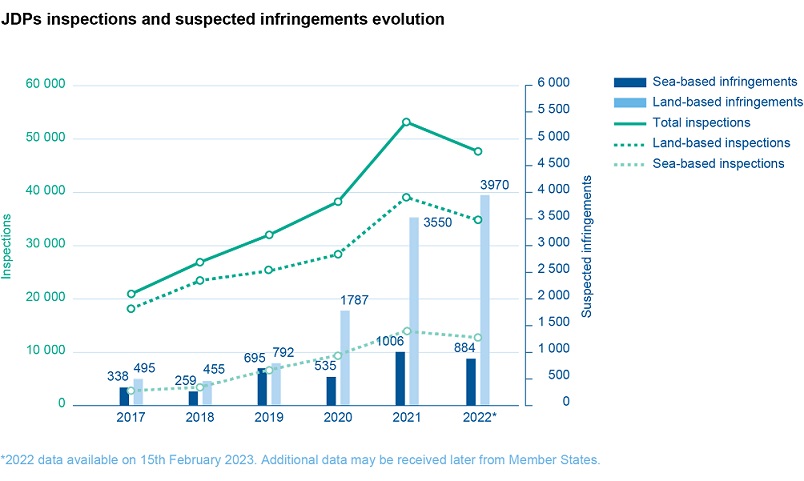
- Specifically, the activity focused on joint coordination and enhancement of the potential of national enforcement services to apply the rules of the Common Fisheries Policy in a uniform and effective manner. The cooperative efforts led to 47 592 coordinated inspections, and 5 167 inspections reported with at least one suspected infringement. In accordance with the results of the regional risk analysis, priority was given to the control of fisheries with the highest risks.
- During 2022, the Agency was granted additional resources to provide technical assistance in the monitoring, control and surveillance regime harnessed to the Common Fisheries Policy, including the measures entailed by the Trade and Cooperation Agreement (TCA) with the UK. The North Sea and Western Waters JDPs, continued to operate with the established Virtual Coordination Network (VCN), aiming to enhance a common situational awareness picture, and focus on risks related with the Trade and Cooperation Agreement with the UK.
- Also, EFCA´s work included three new projects covered by the European Maritime Fisheries and aquaculture Fund (EMFAF).
- EFCA cooperated with the Control Expert Groups of the main regional bodies created in the framework of regionalisation, such as BALTFISH, Scheveningen, NWW and SWW CEGs. The main areas of activities were the common understanding on the application of control rules; regarding the implementation of the Landing Obligation, risk assessment, evaluation of compliance and remote electronic monitoring.
- Last year EFCA finalised the evaluation of compliance with the LO in the mackerel fisheries in the North Sea and North-western Waters, and in the fisheries for demersal species in the North Sea.
- The working group on Remote Electronic Monitoring to assist regional and national pilot projects was reactivated.
In the international dimension of the Common Fisheries Policy, EFCA continued to assist the European Commission in the fight against Illegal, Unregulated and Unreported (IUU) fishing activities, and to cooperate with third countries and international organisations dealing with fisheries, such as Regional Fisheries Management Organisations (namely, NAFO, NEAFC, ICCAT and GFCM).
In the framework of the six-year EU funded PESCAO project, including a component aiming to improve the fight against IUU fishing activities in Western Africa, EFCA continued to provide technical assistance to the Sub-Regional Fisheries Commission (SRFC), the Fisheries Committee for the Western Central Gulf of Guinea (FCWC) and their member countries, in a coordinated manner, using the experience gained in the EU context.
Supporting national authorities carrying out Coast Guard Functions, EFCA led a project assigned by the European Commission to update the Practical Handbook on European Cooperation on Coast Guard Functions, which included the follow-up of the European Coast Guard Functions Academies Network Project (ECGFA-Net) and a dedicated Portal for the EU Coast Guard cooperation with the other maritime Agencies, EMSA and Frontex.
Another important area in EFCA’s work is training, as a capacity building tool. Training activities are crucial to guarantee a fair and equitable treatment to the Union operators. Last year 2 967 officials were trained, including by e-learning.
EFCA’s chartered Offshore Patrol Vessels (OPVs), the Lundy Sentinel, Aegis and, since December 2022, the Ocean Sentinel, provided a robust platform for fisheries inspections. The EFCA chartered OPVs contributed to the implementation of JDPs in the EU sea basins by adding capacity to fisheries control operations outside the territorial waters of the MS. They were also a platform to deploy multinational inspection teams, including inspectors from Third Countries. This promoted transparency, a level playing field for the fishing industry and fostered a good exchange of knowledge and expertise.
In relation to EFCA’s information systems, these ones enabled the collection of data from each Member State providing details of their fishing vessels, catches and other such information. Overall, EFCA received Electronic Reporting System (ERS)-logbook data from 6 109 vessels from 12 Member States and Vessel Monitoring System (VMS) data from vessels, throughout all Member States concerned by JDPs.
The EFCA IMS application was used by a large community of Member States users as a support to fisheries control and activities against IUU fishing.
“I would like to take this opportunity to thank sincerely EFCA staff for their excellence and professionalism. Also, I want to thank the Member States and the European Commission for their trust in me in the important task we have ahead. This is an agency committed to move forward towards the vision of a sustainable future for our oceans,” said Susan Steele, EFCA Executive Director.
Source: https://www.efca.europa.eu/en/content/pressroom/efca-administrative-board-adopts-its-annual-report-2022