New study advances understanding of FIFO and introduces industry tool to optimise marine resource efficiency
A new study has traced the evolution of the widely used Fish In: Fish Out (FIFO) metric and highlights how it can now be used to assess the retention of essential omega-3 fatty acids from wild fish into farmed seafood.
Published in Reviews in Fisheries Science & Aquaculture, the research argues that FIFO metrics should be better aligned with Life Cycle Assessment (LCA) methodologies – the same framework used to measure carbon footprints and other environmental impacts – while also supporting broader food system objectives such as the sustainable provision of essential nutrients to a growing global population.
A key outcome of the study is the introduction of the FIFO Performance Tool, developed by Blue Food Performance. The accessible industry tool enables stakeholders to calculate and optimise FIFO metrics in line with industry standards and Product Environmental Footprint Category Rules (PEFCR)-compliant LCAs.
Building on the findings of the published research, the tool has recently been updated to allow users to compare species diets, benchmark alternative ingredient scenarios, and evaluate FIFO performance across different production systems.
The integration of these outputs into wider sustainability assessments and reporting frameworks is expected to support more consistent, transparent and credible decision-making throughout the aquaculture sector.
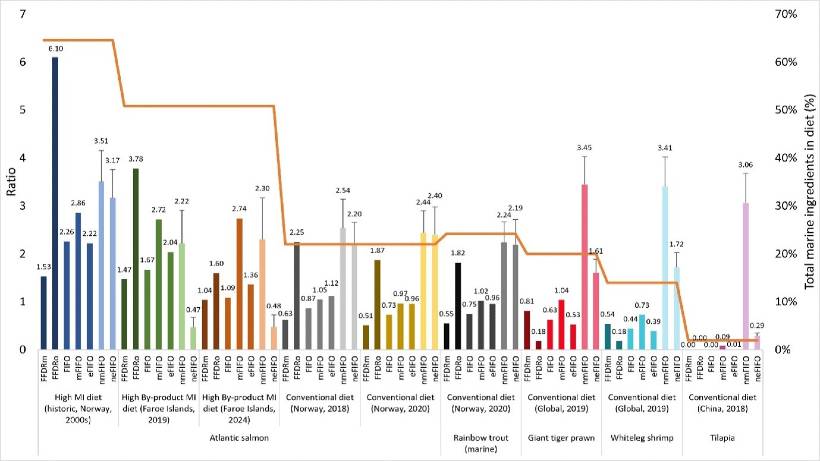
Figure 1: Fish dependency (dark shade), fish efficiency (medium shade), and nutrient (EPA+DHA) efficiency (light shade) metrics, for key aquaculture species, as calculated using the FIFO Performance Tool. Values can vary within species depending on diet composition, production system, and other environmental or management conditions.
The study was led by Dr Wesley Malcorps of Blue Food Performance and the University of Stirling’s Institute of Aquaculture, in collaboration with researchers from the Stockholm Resilience Centre in Sweden. Using the FIFO Performance Tool, the team analysed the efficiency of a range of historical and contemporary aquaculture diets.
Their findings showed that Atlantic salmon farmed in the Faroe Islands and tilapia farmed in China can act as net producers of edible EPA and DHA omega-3 fatty acids, achieving a nutritional FIFO (neFIFO) score below 1.0. This performance was largely attributed to the use of marine ingredients derived from fishery by-products, resources that would otherwise be unlikely to enter the human food chain directly.
The research builds on a growing body of work examining marine ingredient use in aquaculture, with particular emphasis on fish conversion efficiency and nutrient retention. It also compares the various methodologies currently used to assess fish dependency and fish efficiency across aquaculture systems, drawing on case studies involving different species and feeding strategies.
According to the authors, the findings reinforce the need to optimise marine resource use within global food systems. Rather than viewing fisheries and aquaculture as separate sectors, aquatic food production should be considered as part of a continuum focused on maximising the availability of essential nutrients for human consumption.
Industry interest in the FIFO Performance Tool is already growing, with more than 100 users adopting the platform to date. These include major aquafeed manufacturers, one of which has already incorporated the outputs into its 2025 sustainability impact report, as well as emerging ingredient companies, NGOs and academic researchers.
Industry reaction
Dr Wesley Malcorps, Study Lead, CEO of Blue Food Performance and Research Fellow at the Institute of Aquaculture, University of Stirling, said:
“A unified ‘fish-as-feed’ sustainability framework moves us from fragmented, unverified claims to credible impact through consistent measurement, clear comparability and shared transparency. It provides the foundation for a common language the industry can scale across other sustainability priorities.”
Dr Richard Newton, LCA Specialist at Blue Food Performance and Lecturer in Resilient Food Systems at the Institute of Aquaculture, University of Stirling, added:
“nFIFO was the culmination of years of evolution of metrics measuring the efficiency of using marine ingredients in aquaculture. We have to become much more efficient with our resources to deliver not just food, but quality nutrition. This study demonstrating the application of nutritionally sensitive metrics shows that it is possible.”
The paper, Fish as Food or Feed? Aligning FIFO with LCA and Food System Objectives, is published in Reviews in Fisheries Science & Aquaculture.