The Women’s Day Off in Iceland. Fish Focus’ latest feature follows our trip to the Icelandic archipelago, Vestmannaeyjar.
We will be posting an article every day, covering this amazing trip and showcasing the Icelandic Seafood industry, cutting edge aquaculture, Icelandic heritage and the hospitality of the Icelandic people. You can read the whole publication here
During the flight with Icelandair, we watched a film called ‘The Day Iceland Stood Still’ a multi-award winning documentary celebrating the extraordinary events that led up to the ‘Women’s Day Off’ – a day when courageous Icelandic women walked out of both paid work and household duties, effectively bringing the nation to a halt and highlighting their indispensable contributions to society.

Director Pamela Hogan, working with Icelandic producer Hrafnhildur Gunnarsdóttir, created an inspiring, visually engaging and often humorous piece of historical cinema that balances celebratory narrative with thoughtful reflection. It succeeds not just as a commemoration of a pivotal event, but as a reminder of the unheralded labour that underpins society, and why remembering such stories matters.
For more information please visit: https://www.thedayicelandstoodstill.com/
Kvennafrí and the Fight for Equality
On October 24, 1975, Iceland witnessed one of the most remarkable demonstrations for gender equality in modern history: the Women’s Day Off, known in Icelandic as kvennafrí. On that day, 90% of Icelandic women walked off the job and refused to perform both paid work and unpaid household labour. The event became a turning point in Iceland’s struggle for women’s rights and helped reshape the nation’s political and social landscape.
By the mid-1970s, Icelandic women were highly active in the workforce, but they faced persistent inequalities. On average, they earned significantly less than men, and household duties were still overwhelmingly seen as their responsibility. Representation in politics was dismal: only a small fraction of parliamentary seats were held by women.
Globally, the United Nations had declared 1975 the International Women’s Year, sparking discussions and actions across many countries. In Iceland, women’s organisations saw an opportunity to make their voices heard on a national stage.
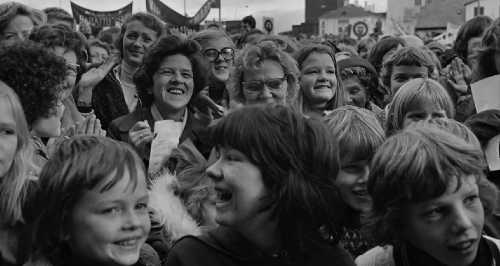
The Day of Protest
Rather than calling it a “strike,” organisers framed the event as a “day off” (kvennafrídagur) to emphasise inclusivity and avoid alienating participants. The idea was simple but radical: if women stopped working, both at their jobs and in their homes, society would feel their absence.
On October 24, an estimated 25,000 women (nearly one-fifth of Iceland’s entire population at the time) gathered in Reykjavík’s city centre, with thousands more joining rallies across the country. The protest was not limited to activists or professionals, but included women from all walks of life, from teachers and nurses to factory workers and homemakers.
The results were immediate and striking. Schools and nurseries closed, leaving fathers scrambling to care for children. Businesses and offices struggled to operate. Daily life in Iceland was disrupted, vividly proving how essential women’s labour was to the functioning of society.
The Women’s Day Off changed Iceland. Just five years later, in 1980, Iceland elected Vigdís Finnbogadóttir as the world’s first democratically elected female head of state, a milestone many link directly to the momentum created by the 1975 action.
Since then, kvennafrí has been repeated on multiple occasions (e.g., in 1985, 2005, 2010, 2016, 2023 and 2025), often to protest continuing gender pay gaps and to demand broader equality. Each time, the spirit of 1975 is evoked, reminding Icelanders of the unfinished work of the women’s movement.
A Legacy Beyond Iceland
The Women’s Day Off has become an enduring symbol of collective action. It demonstrated that when women withdraw their labour, both visible and invisible, societies are forced to reckon with their dependence on gendered structures of work. The 1975 protest is frequently cited in global feminist history as a pioneering example of how peaceful, mass mobilisation can produce tangible political change.
Fifty years later, the Women’s Day Off remains one of the most powerful demonstrations of solidarity in the fight for equality. It not only altered the course of Icelandic politics but also inspired movements worldwide. Kvennafrí is more than a single event in history—it is a living tradition, a reminder that progress is achieved when women refuse to remain silent or invisible.
Main image: Photo © Reykjavik Museum of Photography