ASC BRINGS GHANA MODEL FOR AQUACULTURE IMPROVEMENT TO GLOBAL FAO DISCUSSIONS

ASC Brings Ghana Model for Aquaculture Improvement to Global FAO Discussions
Aquaculture Stewardship Council (ASC) highlighted how certification, improvement programmes and collaboration with governments and industry can help turn global aquaculture goals into practical action at the 37th Session of the FAO Committee on Fisheries (COFI37), which took place in Rome from 7–11 September 2026.
A key focus was ASC’s work in Ghana, where ASC, the Ghana Fisheries Commission and Chamber of Aquaculture are co-developing a national Code of Good Practices – demonstrating how the FAO Guidelines for Sustainable Aquaculture (GSA) can be applied at country and producer level.
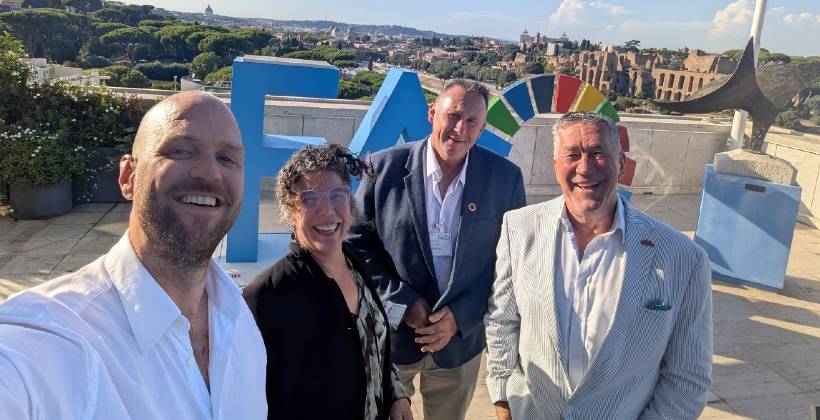
ASC CEO Chris Ninnes and Head of the Improver Programme by ASC, Roy van Daatselaar, contributed to discussions at COFI37, sharing how independent standards, improvement pathways and partnerships can support progress across a sector where producers operate in different contexts and at different stages. They were joined by Bertrand Charron, ASC Global Director of Research & Insights, and Patricia Bianchi, ASC AIP & Governance Manager.
Chris said, “Independent standards that provide certification and credible improvement pathways can help translate global ambition into practical requirements and measurable progress. Only by including the entire value chain (including the ingredient sourcing for feed production) can the Guidelines be delivered.

From global guidelines to local action: ASC highlights Ghana partnership at COFI37
“We also know that the performance of farming systems differs enormously globally. Implementation pathways to deliver change must build commitment for their direction and end goal, and for the services that facilitate this.
“The development in Ghana of a Code of Good Practice, facilitated by ASC, takes this approach. Supported by the Ministry and Chamber of Aquaculture we will launch this Code at the World Aquaculture Society meeting in Tanzania in December 2026.”
Ghana shows implementation in practice
During a Speaker’s Corner session, Chris and Roy explored how the FAO GSA can be applied in practice in Ghana. As part of the project, ASC mapped the Guidelines against the practical, farm-level requirements of the ASC Farm Standard. Building on this work, ASC has worked with stakeholders in Ghana to develop an industry Code of Good Practices.
Ghana’s aquaculture sector is growing quickly, supported by an expanding domestic market and strong demand for tilapia and catfish. Since 2025, ASC has been working with the Fisheries Commission and the Chamber of Aquaculture to develop a voluntary, Ghana-owned Code of Good Practices for responsible aquaculture. It is designed as an accessible entry point for producers to demonstrate improvement, bridging the gap between international standards and contextualizing best practice into a local reality. The Code will act as a framework to support the Ghana industry on its commitment towards responsible production, improving access to finance and investment, and creating opportunities for market differentiation. By creating incentives for compliance – the Code is aligning private-sector efforts on sector development, with public-sector ambitions to implement the FAO GSA.
Roy said, “This is a great example of how private-public collaboration can harness a shared vision on how responsible aquaculture can contribute to environmental sustainability and social responsibility, whilst contributing to economic development, food and nutritional security.
“This has been a genuine co-development process, not ASC handing over a standard. We have engaged farmers, feed companies, financial institutions and government from the start, alongside wider stakeholder consultations. That local ownership is essential if international ambitions are going to translate into changes that work in practice.”
The Code is structured around four pillars drawn from the ASC Farm Standard: legal compliance, environmental performance, social responsibility, and animal health and welfare. Wherever possible, these are anchored in existing Ghanaian legislation.
From Ghana to wider aquaculture improvement
While developed for Ghana, the approach has potential relevance for other countries looking to grow aquaculture while helping producers progressively improve their environmental, social and animal welfare performance.
Through its participation at COFI37, ASC is bringing the Ghana experience into wider discussions on how international guidelines can support locally led approaches to aquaculture development.
Caption: © ASC team at COFI37, engaging with global stakeholders on the future of aquaculture