NORTH EAST TECH FIRM BACKS MARINE CHARITY’S ‘GHOST GEAR’ COASTAL CLEAR-UP

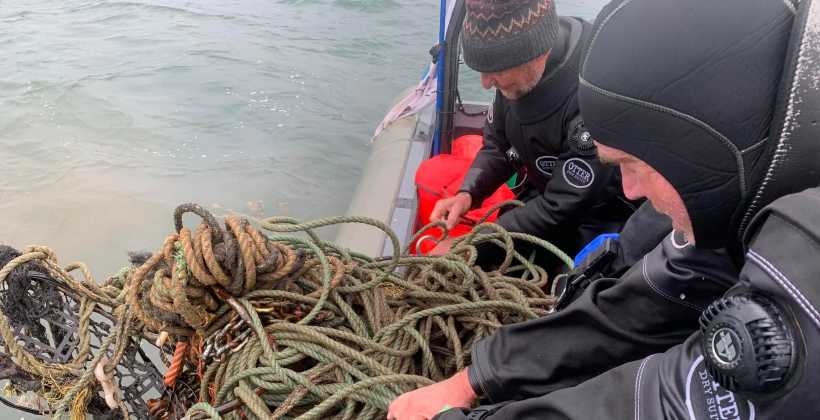
North East tech firm backs marine charity’s ‘ghost gear’ coastal clear-up drive with £10,000 equipment donation. A North East technology firm has teamed up with a regional marine charity to help reduce the ocean pollution and habitat damage caused along the North East coast by so-called ‘ghost’ fishing equipment.
Succorfish has donated £10,000’s worth of its MyGearTag technology to Clean Planet UK, a Middlesbrough-based group of volunteer divers who find, recover and recycle lost fishing nets, pots and traps along a 25-mile stretch of the North East coastline that runs from Seaham to Skinningrove.
MyGearTag is a state-of-the-art underwater acoustic location device that uses miniaturised modem technology to enable lost nets, pots and traps to be located and recovered over a range of up to three kilometres.
It has a protective, waterproof exterior made from recycled fishing nets, weighs just 500 grammes and includes a four-centimetre diameter modem which emits a regular pulse that is picked up on an app-based directional tool and enables owners to quickly find their missing equipment.
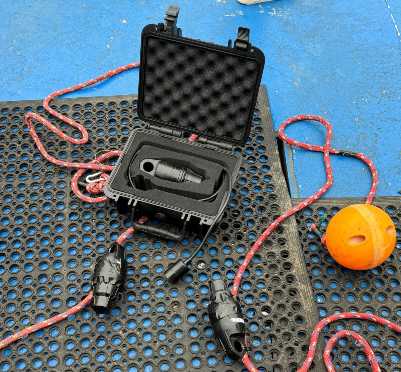
MyGearTag
The MyGearTag units will enable the Clean Planet UK team to mark the location of ghost gear that they can’t immediately recover, so they know where to find it on their next trip out to sea and so have less risk of losing it if it’s moved by the ocean currents in the meantime.
The data will also show how ghost gear is moving around the ocean floor off the North East coast and will help the team identify any hotspots where they can focus their efforts.
Almost half of the plastic in the world’s oceans is currently thought to be lost or discarded fishing gear, while between half a million and one million tonnes of fishing gear is estimated to be lost at sea every year around the world.
Clean Planet UK was founded by local diver Stephen Smith after he noticed ghost fishing gear on the seabed while diving near Redcar more than a decade ago, and is the only organisation of its kind that’s currently active in North East coastal waters.
The group began to attract other volunteers divers, with the team managing to collect more than 200,000m of fishing line in its first two years.
It achieved charitable status four years ago and got its own boat in 2024, which the 15-strong team now uses to work around the 100+ wrecks that lie off the Redcar coast, with a sounder used to locate them or any other anomalies on the seabed that could be ghost gear.
Stephen Smith says:
“The extent of ghost gear on our seabed was very obvious when I first began diving in the area and our efforts to clean as much of it up as we can being benefits for everyone involved.
“Not only does it make for a cleaner diving environment, but there’s damage being caused to sea life and underwater habitats and, if we can reunite the lost kit with its owners, there’s less of a financial cost to the fishing industry too.
“We prioritise recovering equipment that’s been recently lost, as there’s more chance of it being reusable when we pull it out of the water, and we’re increasingly being asked by local fishermen if we can find nets and lines that they’ve lost in a particular location.
“The weight of this equipment, the sea conditions or simply the time of day that we find it can all mean that we can’t remove everything in one go, and if it’s not in the same place when you go back for the rest, it really could be anywhere.
“Having the MyGearTag location devices that we can fit to what we leave behind will make it easier to find it all again on our next trip and will make a massive difference to the amount of ghost gear we’re able to remove.”
MyGearTag is manufactured and assembled in the UK, and was developed by Succorfish in partnership with Professor Jeff Neasham and the SEA Acoustic Laboratory team within Newcastle University’s Faculty of Electrical and Electronic Engineering and the pan-European NETTAG+ project, with grant funding provided by UK Research & Innovation and the European Union.
Chad Hooper, founder and CEO at Succorfish, says:
“Fishing equipment can be lost for many reasons, such as bad weather causing lines to break or being accidentally dragged away from where they were left by other boats’ gear, and unless its owners know where it’s gone, it can be almost impossible to find.
“MyGearTag allows for lost fishing nets, pots and traps to be quickly located over a wide area, thus avoiding the substantial cost of replacing them, reducing the amount of plastic in our oceans and preventing more damage being caused to marine life and environments.
“MyGearTag is unique it in terms of its size, cost, low power use and effectiveness, while the low-level noise that its emits has been specifically designed to minimise any impact on the underwater environment.
“The Clean Planet team has been doing some amazing work under their own steam for several years and the MyGearTag equipment we’ve provided will enable them to make even more of a difference to the marine environment off this part of the North East coast.”
Main image; Clean Planet UK