WORLD’S OCEANS BREAK JUNE HEAT RECORD


World’s oceans break June heat record
Daily global sea surface temperatures break records for the time of year
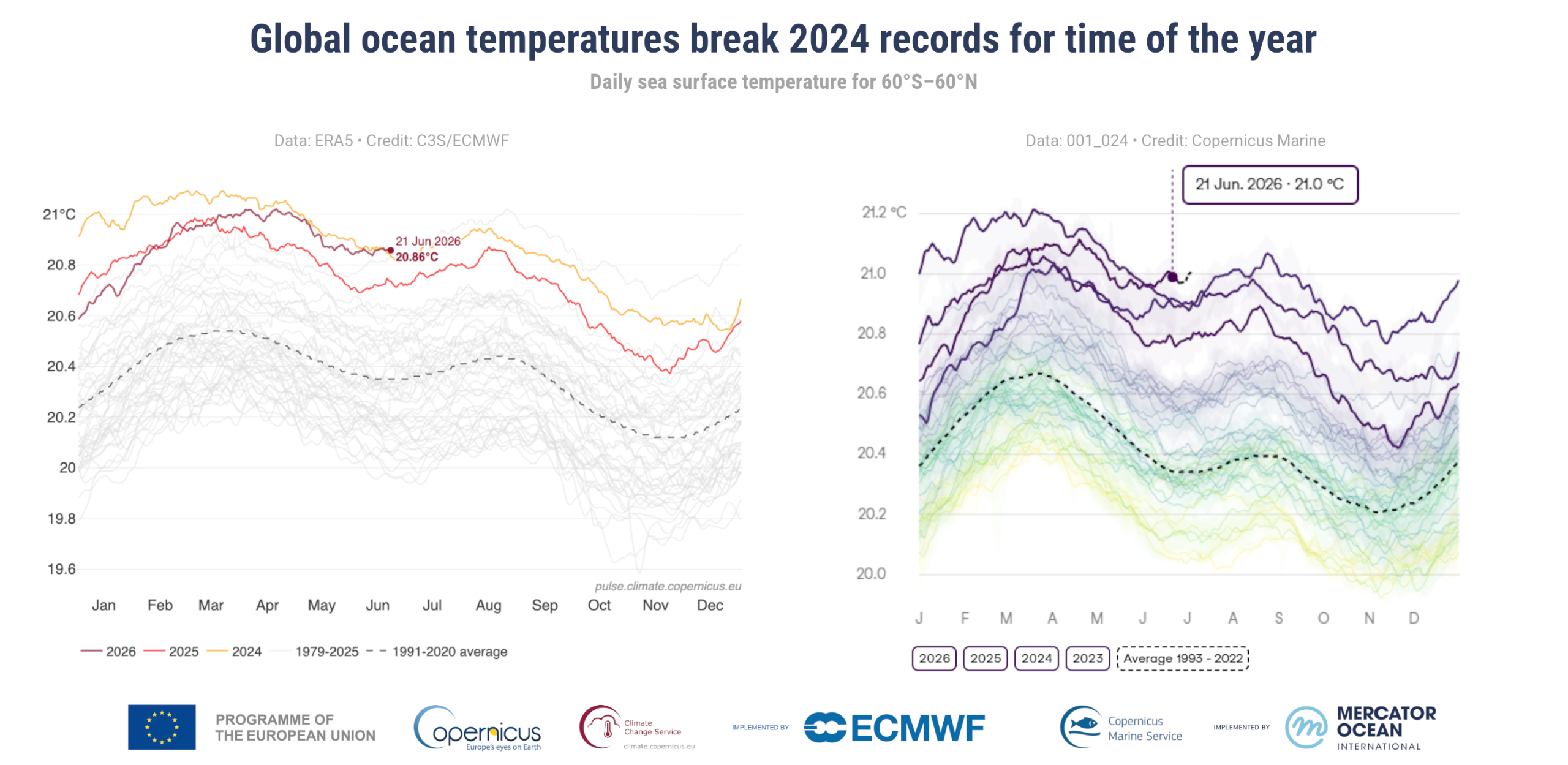
This image combines graphs created with the free applications Climate Pulse and MyOceanHealth.
The Copernicus Climate Change Service (C3S) and the Copernicus Marine Service (CMEMS) both confirmed that the global sea surface temperatures (SST) have now exceeded the record levels for the time of the year observed in 2023 and 2024. C3S daily SST data exceeded the 2024 levels on 21 June at 20.86ºC, marginally above the 20.83ºC observed in 2023 and 2024. Copernicus Marine daily SST data also indicate record‑high temperatures on 21 June, reaching 21.0 °C and beating the previous records from 2023 and 2024 by 0.1 °C.
This new global sea surface temperature record for the time of year was expected with the onset of El Niño conditions in the Equatorial Pacific, announced by the World Meteorological Organization (WMO) on 2 June 2026, in addition to unusually high SST observed in several ocean regions over recent months. This record is expected to have consequences for both weather patterns, global climate, and marine ecosystems.
Over the past three years, the global ocean outside the polar regions (between the 60°N and 60°S latitude) has been between 0.35º C – 0.73º C warmer than the long-term average, and in June these anomalies have now reached record-high levels for the time of year.
The Copernicus Climate Change Service, implemented by the European Centre for Medium-Range Weather Forecasts (ECMWF) and the Copernicus Marine Service, implemented by Mercator Ocean International jointly announce this unprecedented level of warming of the global extrapolar ocean for the time of year, reflecting both our changing climate and the onset of an El Niño event whose strength, according to the C3S ensemble of seasonal forecast models, is likely to reach levels not seen in decades.
“Current conditions could indicate the beginning of a new phase, leading, once more, to uncharted territory. With ocean temperatures at these levels and El Niño on the horizon, we are likely to see more temperature records fall in the coming months. That Copernicus Marine data reaches the same conclusion through independent methods speaks to the strength of European science — and to why open, robust data matters now more than ever.” said Carlo Buontempo, Copernicus Climate Change Service Director at ECMWF.
“Continuous monitoring of the ocean by the Copernicus Marine Service helps public authorities, scientists and decision‑makers understand how the ocean is changing and supports policies to protect the marine environment. One of the key strengths of the EU Copernicus programme is the close cooperation between the Copernicus Climate Change Service and the Copernicus Marine Service: C3S provides the broader Earth-system climate perspective while Copernicus Marine delivers detailed ocean analyses and forecasts, from the physical environment to marine ecosystems,” said Pierre-Yves Le Traon, Scientific Director of the Copernicus Marine Service at Mercator Ocean International.
Whether this exceedance is temporary or indicative of conditions in the months ahead remains to be seen. While temperatures reaching record levels for this time of year is significant, it is consistent with the onset of El Niño — announced by WMO and declared by the NOAA on 11 June — and with the record sea surface temperatures observed in the northern Pacific in previous months. By contrast, when global SST last reached record levels for this date in June 2024, ENSO conditions were returning to neutral after the El Niño event starting in spring 2023.
A warmer ocean has wide-ranging impacts. Higher ocean temperatures, keep the atmosphere warm for longer, provide extra energy to storms and increase evaporation, thus enhancing the potential for extreme precipitation and flooding. Ocean warming also contributes to sea level rise and ice melt, and stresses marine ecosystems.
Higher SSTs are also associated with more frequent and intense marine heatwaves—periods of unusually high ocean temperatures that disrupt ecosystems and fisheries, affect coastal economies, which can also intensify heat extremes over nearby land areas.
Additionally, an El Niño event is a source of heat for the atmosphere, increasing global temperature and shifting weather patterns across the globe.
Two systems, same conclusion
These record values are seen independently in both the C3S ERA5 reanalysis, produced by ECMWF, and the Copernicus Marine GLO12, produced by Mercator Ocean International. ERA5’s SST can be monitored with the Climate Pulse application, and GLO12’ SST data can be monitored through the MyOceanHealth platform.
Together, the two services rely on a combination of in‑situ and satellite observations, including data from ESA and EUMETSAT, which are integrated into Copernicus models to provide short-term, high-resolution ocean and marine ecosystems forecasts (Marine Service) and, longer-term ocean and atmosphere-scale seasonal forecasts (Climate Change Service).
Copernicus scientists continue to monitor the situation to determine whether the exceedance is temporary or persistent. Nevertheless, with forecasts pointing to a likely strong El Niño, it is anticipated that global temperatures will see new records in the coming months, both in the ocean and in the surface atmosphere.
Main Image by Franziska Stier from Pixabay