MARINE HEATWAVES ARE CLOSING THE WINDOW FOR CORAL REEF RECOVERY


Marine heatwaves are closing the window for coral reef recovery. The most comprehensive assessment of the status of coral reefs ever published shows that climate-driven marine heatwaves are reshaping reefs worldwide; scientists call for urgent, evidence-based action to safeguard the future of coral reefs.
-
21.1 million observations from 36,886 reef sites across 124 countries and territories make this the largest global assessment of coral reefs ever undertaken.
-
9.5% relative decline in global hard coral cover since historical levels (1980–2009), driven primarily by human-induced climate change.
-
~6% relative recovery in global hard coral cover between 2017–2019, showing reefs can recover when given sufficient time between disturbances.
The world’s coral reefs are running out of time to recover between increasingly frequent marine heatwaves and global bleaching events driven by human-induced climate change, according to the Status of Coral Reefs of the World: 2025.
Released today by the Global Coral Reef Monitoring Network (GCRMN), the report draws on more than 40 years of global data from 21.1 million observations, 87,299 surveys, representing 36,886 sites across 124 countries, territories and economies, making it the most comprehensive assessment of coral reef status ever undertaken. It provides the clearest picture yet of how climate change and local pressures are reshaping coral reefs worldwide, and how action today can strengthen resilience for the future.
“After decades of studying coral reefs, what concerns me most isn’t the current loss of hard coral cover; it’s that we’re steadily eroding the conditions they need to recover,” said Dr Manuel González Rivero, lead author of the report. “Climate change is driving more frequent and severe marine heatwaves, but local pressures such as poor water quality, overfishing and coastal development are making reefs even less able to withstand them. So we have to do two things at once: reduce emissions at the global level and implement science-based conservation measures at the local level.”
Coral reefs are running out of recovery time
Since 1998, every major global bleaching event has reduced global hard coral cover, with reefs only partially recovering before the next marine heatwave strikes.
Estimated global loss in hard coral cover following each global bleaching event:
-
First Global Coral Bleaching Event (1998–1999): ~6.5% decline
-
Second Global Coral Bleaching Event (2010–2011): ~9.9% decline
-
Third Global Coral Bleaching Event (2016–2017): ~6.6% decline
-
Fourth Global Coral Bleaching Event (2023–2024): ~8.9% decline
“Coral reefs once had decades to recover after major bleaching events. Today, they’re lucky to get five or six years,” said Dr González Rivero. “And for many reefs affected by the unprecedented marine heatwaves in 2024, this year’s El Niño likely means they’ll have had little more than a year to begin recovering before being hit again. This is creating a staircase of decline that becomes harder to reverse with every bleaching event.”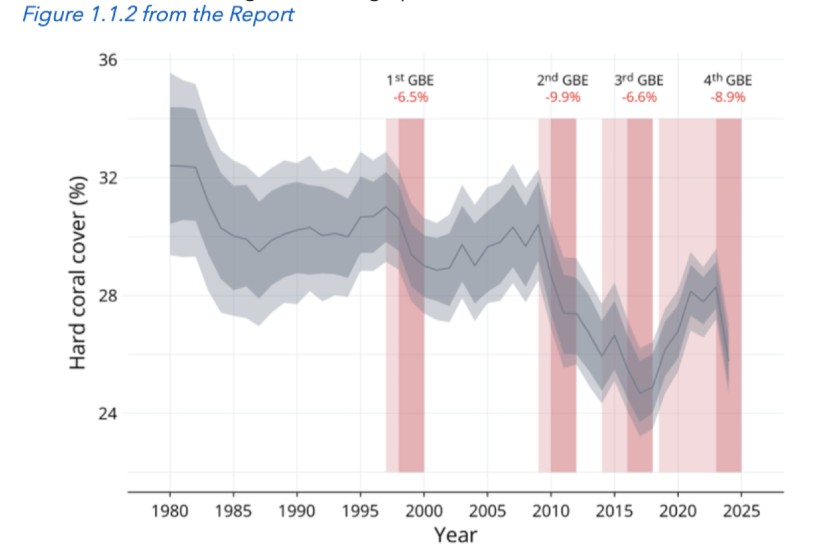
Reefs can still recover when given the chance
Despite the long-term global decline, the report also shows that coral reefs have the potential to recover when given the opportunity. Following the third global coral bleaching event, global hard coral cover saw a relative increase of approximately 6% between 2017 and 2019, demonstrating that reefs have maintained their natural capacity to regain hard coral cover when disturbances are reduced and sufficient recovery time is available.
That recovery matters because the benefits coral reefs provide extend far beyond the reef itself. Coral reefs cover less than 0.2% of the ocean floor. Yet, they support at least 25% of all marine species and underpin food security, livelihoods, coastal protection, tourism and cultural heritage of close to one billion people worldwide. Today, around 104 million people live within five kilometres of a coral reef. This is a 46% increase over the past two decades, highlighting both growing dependence on reef ecosystems and increasing pressure on them.
“Our economies depend on nature, and the continuing decline in coral cover revealed in this report must shake us out of our persistent inertia,” said David Obura, Chair of IPBES.
“GCRMN’s long-term monitoring tracks not just the pulse of coral reefs, but of our planet too. It shows which regions are under the greatest pressure, that actions to date have not been sufficient, and warns where reefs will be under increasing threat in years to come. We must act now to halt this decline and invest in solutions that reduce pressures and build resilience, while sustaining the monitoring that turns good intentions into effective policy. The 40 years of data in this report provide a strident warning that delayed action risks locking in irreversible losses – not just to reefs, but also to the economies and people that depend on them.”
It finds that, under the current frequency of global bleaching events (every 5-6 years), coral reefs are expected to continue on a trajectory of decline. By contrast, ambitious emission reductions combined with effective management of local pressures – overfishing, coastal development, poor water quality – offer the strongest pathway to maintain hard coral cover.
“We know what works. Local conservation efforts, effective marine management, and the integration of Traditional Knowledge with scientific innovation have already shown positive results in many parts of the world and offer powerful solutions. The challenge before us is no longer identifying what needs to be done, but finding the collective will to do it,” said Ambassador Ilana Seid, the Permanent Representative of Palau to the United Nations.
Different futures are still possible
From 1980 to 2024, global hard coral cover has declined from an average of 30.2% (between 1980 and 2009) to 27.3% (2020-2024), a relative decline of approximately 9.5%. The report identifies climate change-induced heat stress as the primary driver of this decline.
The report also explores how coral reef futures could unfold under different scenarios by simulating different recovery times between global bleaching events over the century.
Image by Manuel de la Fuente from Pixabay