RAS-BASED AQUACULTURE SET FOR STRONG GROWTH AT 8.5% CAGR

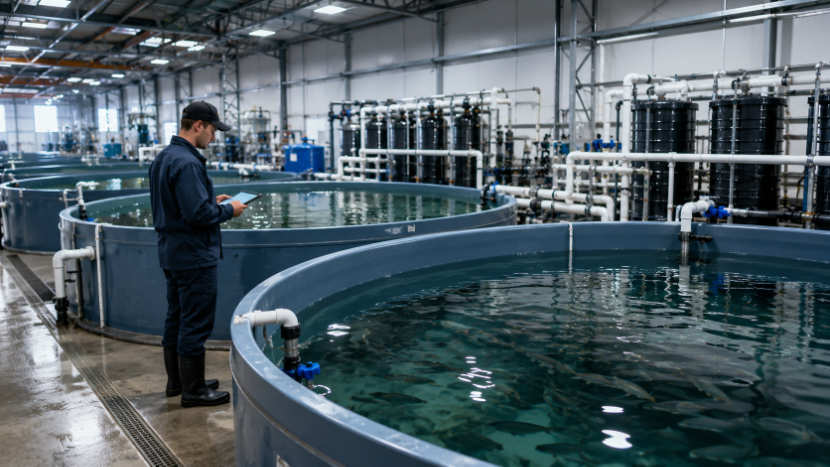
The Recirculating Aquaculture Systems (RAS) industry worldwide is set to almost double its valuation over the coming eight years, rising from the current level of some $3.8 billion to an estimated $7.2 billion by 2033, with producers, regulators and investors rallying behind the technology that delivers cleaner water, healthier fish and less environmental impact. This technology, which had been seen in the past as an expensive alternative to net pens, is rapidly gaining favor as the go-to system for a new wave of aquaculture installations.
Dataintelo says that the approximate market size for RAS across the globe in 2025 is estimated to be worth $3.8 billion, which will rise to $7.2 billion by 2033, at an 8.5% CAGR rate from 2026 to 2033. From the data presented above, it is evident that the market size will increase in value from $4.1 billion in 2026 to $4.8 billion in 2028 and exceed $5.6 billion in 2030 and end up at over $7.
Where the industry has been historically linked with cage-based and pond-based systems, such rapid growth indicates that the RAS system is now becoming mainstream within the industry.
Reasons Why Growth Is Accelerating
The rationale behind RAS can be explained simply: Wild-caught fisheries have reached a limit at about 90 million tonnes annually, but worldwide consumption of seafood will approach 204 million tonnes per annum by 2033. This shortfall will have to be made up for by aquaculture, and RAS is one way to boost production without the space, water, and proximity to coast required for normal farming operations. Closed-loop systems make water usage about 99% more efficient than flow-through systems, reduce discharge of waste into waterways, and enable producers to keep their stocks at far higher densities – 350 kg per cubic metre annually versus roughly 50 kg in standard ponds.
In fact, regulation is as much a factor in driving adoption as economics. Norway has informed operators that all new licences for salmon must use RAS or closed containment systems by 2030, effectively putting an end to any new open-net licences. Net-pen moratoriums have been introduced in British Columbia and Nova Scotia by the Canadian provinces, the EU’s Water Framework Directive restricts nitrogen discharge to stringent levels, and the US regards concentrated aquaculture facilities as point-source polluters that require licences.
Disease Control Is Becoming a Business Case, Not Just an Environmental One
Biosecurity has turned into one of the strongest commercial arguments for RAS. Norway’s aquaculture sector is estimated to have lost around $600 million between 2017 and 2022 to disease outbreaks in open systems, and RAS facilities can now achieve pathogen removal rates above 99.9% through multi-stage filtration and UV sterilisation, cutting antibiotic use by 80–90%. In shrimp farming, survival rates in RAS systems have risen to 78–85%, up from historical levels of 40–50% in traditional ponds — a difference that goes straight to the bottom line for producers battling diseases such as white spot syndrome.
Equipment Leads, but Monitoring Is the Fastest-Growing Segment
By component, equipment — biofilters, pumps, tanks and aeration systems — remains the largest slice of the sector at 42.3% share, supplied largely by firms such as AKVA Group, Veolia Water Technologies and Xylem. Water treatment system, including filtration systems, UV, and ozone, represent 31.7% share, while monitoring systems represent a relatively low 18.2%, but they are experiencing the fastest growth among the three at around 10.2% annually due to an increasing use of IoT sensors and analytics by commercial farmers.
Fish Production Dominates, But Shrimp Is Catching Up
The fish species generate 51.4% of the RAS income, which includes Atlantic Salmon, Rainbow Trout, and European Seabass; salmon alone contributes about 62% of the RAS production of fish. The crustaceans, including shrimp, contribute 27.3% of the total and are increasing rapidly in Asia as farmers are moving towards closed farming systems due to disease management reasons. Mollusks — oysters, mussels and scallops — round out 15.8% of the sector, largely through hatchery and seed-stock production.
Asia Pacific Leads, North America and Europe Close Behind
Asia Pacific holds the largest regional share at 38.2%, powered by China, Vietnam and Thailand’s scale as seafood producers, alongside India’s growing shrimp sector. North America follows at 28.4%, driven by Canada’s shift away from net-pen salmon farming and a wave of land-based investment across the US Midwest and Pacific Northwest. Europe accounts for 16.8%, anchored by Nordic salmon RAS projects and Mediterranean seabass and seabream production in Italy and Spain. The Latin American and Middle East & Africa regions continue to be smaller at 12.1% and 4.5%, but they are still attracting early-stage investments.
Costs and Risks Continue to Dampen Smaller Countries
The growth story comes with real constraints. Commercial RAS facilities typically require between $5 million and $50 million in upfront capital, with payback periods stretching six to twelve years — a barrier for smaller operators, particularly where financing is expensive or scarce. Around 8–12% of installations experience operational failures such as biofilter collapse in any given year, and supply chain disruptions for biofilter media and control electronics added six to eighteen months to project timelines during 2021–2024. Regulatory uncertainty over water rights and discharge permits in regions such as India, Indonesia and Brazil is also delaying facility development.
A Sector Consolidating Around a Handful of Leaders
The supplier landscape is consolidating, with AKVA Group holding an estimated 22% share through its integrated equipment and software offering, followed by Pentair Aquatic Eco-Systems at around 18%, Veolia Water Technologies at 12%, and Xylem at 11%. Twelve significant mergers and acquisitions took place across the sector between 2022 and 2025, as larger players build out full-service offerings spanning hardware, water treatment and farm management software.
A Technology Whose Time Has Come
Even with the capital intensity and technological hazards associated with the practice, the path is clearly set out. The regulatory bodies are tightening regulations regarding open-water farming, seafood consumption is on the rise, and the price of the RAS systems has been reduced by 25% since 2020 due to advances in biofilter media and monitoring. With an expected increase of almost doubling within the next decade, recirculating aquaculture systems are poised to become the standard in the industry.
Reference: https://dataintelo.com/report/recirculating-aquaculture-systems-market