PRIMARY SCHOOLS INVITED TO JOIN NATIONAL ‘OUR OCEAN, OUR FUTURE’ SHORT-FILM COMPETITION

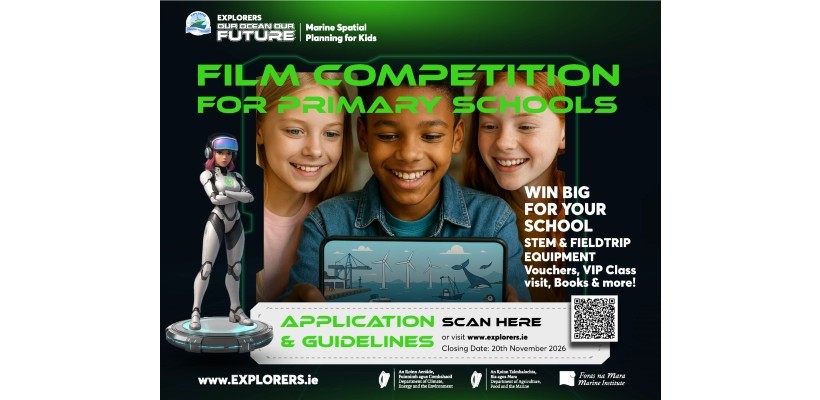
Primary schools invited to join national ‘Our Ocean, Our Future’ short-film competition. LIGHTS, CAMERA, OCEAN ACTION: The Marine Institute and Department of Climate, Energy and the Environment launch the Explorers Our Ocean – Our Future: Marine Spatial Planning (MSP) Short-Film Competition, to integrate marine themes across the primary curriculum through digital storytelling. The competition is funded by the Department of Climate, Energy and Environment. The Explorer’s Education programme is funded by the Marine Institute.
Primary school teachers across Ireland are invited to transform their classrooms into active film production studios for the Marine Institute’s Explorers MSP Short-Film Competition. Launching this autumn, the initiative offers a creative way to integrate marine themes directly into standard curriculum subjects through arts and digital media.
From local marine heritage and rich biodiversity to offshore energy and coastal recreation, Ireland’s seas offer endless opportunities for classroom learning. Marine Spatial Planning helps us manage these vital waters sustainably, balancing wildlife conservation with key human activities like shipping, fisheries, aquaculture, renewable energy, and ocean recreation.
The competition offers a hands-on, cross-curricular project where primary classes produce short films (maximum 5 minutes plus credits) to introduce Our Ocean Our Future – Marine Spatial Planning to their peers, parents, and local communities. Classes have complete creative freedom across genres, including documentary, animation, short drama, poetry, or original musical compositions to tell their story.
“Healthy oceans don’t happen by chance—they happen when we listen, collaborate, and plan for the future together. This competition gives our young people a platform to explore how Ireland can plan and balance biodiversity, support marine industries and jobs, and protect our coastal life. We can’t wait to see their creative vision for our shared marine future,” said Minister Timmy Dooley, Minister of State with special responsibilities for the Marine at the Department of Climate, Energy and the Environment.
The Five Core Competition Themes
Participating classes can choose from five distinct themes to structure their entry:
1. What is MSP? — Explain Marine Spatial Planning and its real-world purpose in an engaging, accessible way that helps friends and family understand how it is used.
2. Our Marine Heritage & MSP — Explore connections to coastal communities, traditional fishing, maritime history, or shipwrecks.
3. Protecting & Restoring Biodiversity — Highlight efforts to safeguard marine species, habitats, and Marine Protected Areas (MPAs).
4. Powering Our Marine Jobs & Economy — Feature sustainable coastal industries, including offshore renewable energy, fisheries, aquaculture, shipping, and sustainable tourism.
5. Our Ocean, Our Future, Our Voice — Share a creative vision for how young people can advocate for sustainable ocean stewardship.
Patricia Orme, Director of Corporate Services, Marine Institute, further added:
“We want to make ocean literacy exciting, accessible, and deeply relevant for primary school students. By combining science, storytelling, and digital tools, children aren’t just learning about the sea—they are becoming active champions for ocean stewardship. All of the Explorers Marine Spatial Planning teaching resources are freely available for teachers and student to access from our Explorers website.”
Developing 21st-Century Skills in the Classroom
Turning the classroom into a studio equips pupils with key lifelong capabilities:
• Digital Literacy: Practical experience filming and editing using tablets, smartphones, or digital cameras.
• Communication & Storytelling: Crafting narrative arcs and interviewing local community members or marine experts.
• Teamwork & Critical Thinking: Working collaboratively to tackle complex, real-world environmental questions.
• Active Citizenship: Empowering pupils to advocate for sustainable marine resource management.
Winning entries will compete across creative categories, including:
• Best Animation: Celebrates stop-motion, claymation, digital animation, or cut-out paper techniques.
• Best Drama or Storytelling: Recognises the best narrative arc, acting, scripting, or character development.
• Best Documentary or Reporting: Highlights investigative reporting, interviewing local experts, or news-anchor style presentations.
• Best Musical or Performance: Awarded for original song composition, poetry, dance, or musical scoring.
Award and Prize Details:
• Top Overall Winner: €1,000 Voucher Prize
• Runner-Up Category Winners: €500 Voucher Prizes x 2
• VIP Outreach Class Visit: A class visit from a VIP outreach officer, supported by EU BlueLights Project – assisting the school towards an EU Blue School Certificate. Includes a seashore safari or interactive ocean activity.
• Classroom Resource Packs: Special collections of books and educational posters sponsored by EU BlueLights awarded across key categories.
Key Dates & How to Get Started:
• Launch Date: Tuesday, 1st September 2026
• Submission Deadline: Friday, 20th November 2026
• Format: Digital Video (Maximum 5 minutes + credits)
• Eligibility: All primary schools across Ireland
Steps to Participate:
1. Download Resources: Access competition guidelines and application form, digital mapping tools, lesson plans, and classroom resources via the Explorers website page: Explorers Marine Spatial Planning
2. Create Your Film: Work with your class to script, film, and edit your entry.
3. Submit Entry: Upload completed video entries links to the official competition email before 5:00 PM on Friday, 20th November 2026.
Image: Marine Institute