MINISTER OF FISHERIES AND OCEAN POLICY OPENS ODE’S NEW OSLO OFFICE

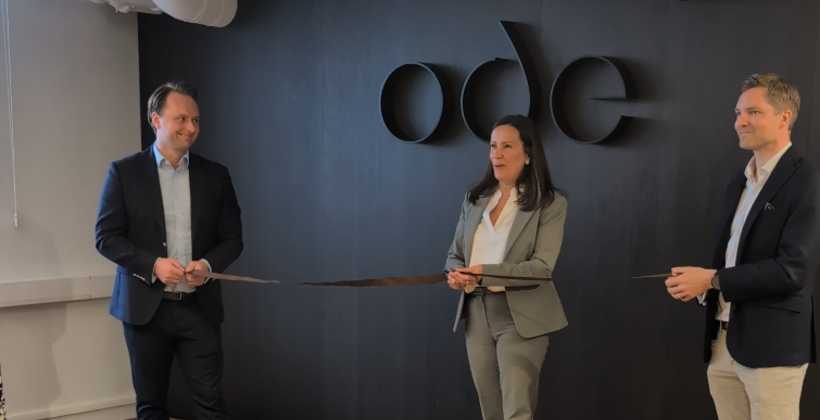
Minister of Fisheries and Ocean Policy opens Ode’s new Oslo office. Minister of Fisheries and Ocean Policy Marianne Sivertsen Næss cut the ribbon on 21 May at Ode’s new office in Oslo. The ribbon was held up by Ode’s two founders, Ola Kvalheim and Tor Olav Seim, in front of customers, partners, employees and invited guests.
In her address, the Minister gave the industry clear support, stating that “cod farming has never been stronger than it is today” — while making clear that she expects the industry to deliver on its challenges. The government will act as a facilitator but will also set requirements.
The opening marks a new chapter for Norway’s largest producer of cod. Founded just over six years ago, the company now has nearly 300 employees and a fully integrated value chain — from roe, fry and juvenile fish, through sea-based facilities along the coast, to slaughter, processing and downstream activities.
The Oslo office will house staff working in sales, marketing, public affairs, communications and digitalisation, serving as a hub for the company’s engagement with customers and public authorities. Headquarters remains in Ålesund, close to operations and production, but the Oslo presence shortens the distance to key decision-making environments. The office has capacity for more than 20 employees from the outset.
“For us, this is about two things: being closer to where decisions are made and being able to recruit talented people who want to help build the aquaculture industry of the future. Oslo gives us access to a broader labour market and makes us more accessible to both authorities and partners,” says CEO Ola Kvalheim.
In his speech, Kvalheim spoke about growing up on the coast and the ambition to support vibrant coastal communities. He highlighted two technologies central to Ode’s approach. Deep operation keeps fish deeper in the water column during the sea phase, improving welfare, production quality and flexibility while reducing the risk of early maturation. Gender sorting addresses the regulatory concern that has most constrained industry growth – the risk of farmed cod spawning in cages and producing viable offspring. Ode will have a solution in place by winter. As Kvalheim put it:
“Having only one gender together will short-circuit the entire discussion about theoretical risk of reproduction and impact.
“We have not gone around the challenges, we have gone into them and worked systematically together with research and regulatory authorities. For our industry to become as large as the UN wants, we must do things right and find good solutions. The future is bright, and challenges like these are best solved when industry, research communities and authorities pull in the same direction,” said Kvalheim.
The company is currently advertising more than 30 open positions, primarily in coastal communities in Norway. We are proud to be becoming a cornerstone business in an ever-growing number of communities along the coast.
Image: Ode