KERRY FRESHWATER PEARL MUSSELS JOIN MARINE INSTITUTE’S CONSERVATION PROGRAMME

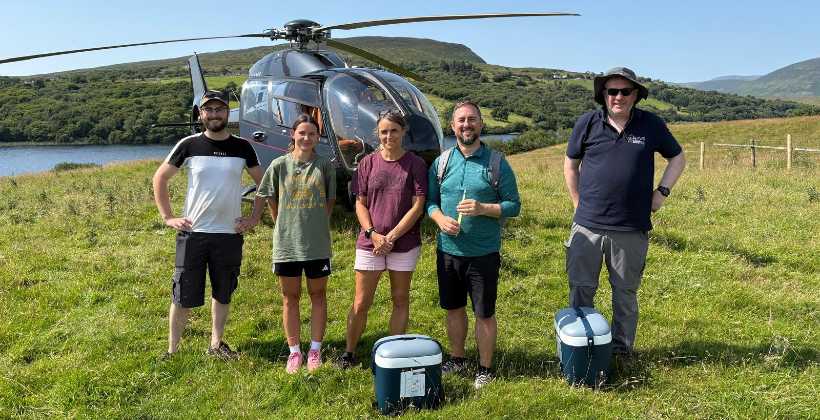
Kerry freshwater pearl mussels join Marine Institute’s conservation programme in Mayo. On July 17th, twenty of Ireland’s rarest freshwater pearl mussels were airlifted from a river in Co. Kerry to the Marine Institute’s Research Facility in Furnace Co. Mayo, as part of the effort to save this critically endangered species.
Their native river is the Owenmore on the north side of the Dingle peninsula, located in the Mount Brandon SAC and the newly created Páirc Náisiúnta na Mara. These new arrivals will join mussels from the Newport River (Co. Mayo), the Owenea River (Co. Donegal) and the Owenriff River (Co. Galway) as part of the conservation breeding programme being run by the Marine Institute, in collaboration with the National Parks and Wildlife Service of the Department of Housing, Local Government and Heritage, and Moorkens & Associates.
The freshwater pearl mussel is an environmentally sensitive freshwater species, owing to its complex life cycle and habitat sensitivity. While adult mussels can live for over 100 years, young mussels spend their first five or more years buried in the riverbed, where they are highly vulnerable to changes in water quality and river conditions. Their survival therefore depends on clean, stable river habitats over many decades.
Because of their sensitivity, the mussels were transported under carefully controlled conditions with a reduced journey time, helping to minimise stress. This transfer comes at a critical time: the Owenmore population is critically endangered and declining. Surveys indicate that fewer than 800 mussels may now remain in the river, compared to approximately 3,000 recorded in 1999. In 2010, the DEHLG warned that, without intervention, the population could disappear within decades.
The pressures affecting freshwater pearl mussel populations are sedimentation and nutrient pollution from upstream land-use practices, which degrade clean, well-oxygenated riverbed habitat. Whilst work to restore the Irish catchments proceeds, captive breeding offers an opportunity to safeguard the freshwater pearl mussel populations and produce juvenile mussels that can be reintroduced into their native river in years to come.
Captive breeding is the practice of breeding endangered or threatened species in controlled environments to preserve populations and support their eventual reintroduction into the wild.
“Captive breeding gives us a window of opportunity for very vulnerable populations of mussels, where habitat restoration will take several decades. Captive breeding works alongside habitat restoration, not instead of it. By preserving the genetic potential of existing populations, we can buy time for restoration efforts to work, helping to secure a future for this species that plays such a key role in our freshwater ecosystems,” said Elvira de Eyto, Marine Institute.
Freshwater pearl mussels (Margaritifera margaritifera) are native to Irish rivers and lakes and are recognised as one of the world’s most endangered species. They are protected under the Wildlife Act 1976 and are listed under the EU Habitats Directive.
Image: Marine Institute