CLEAN CATCH SOUNDS OUT TRIAL WITH PERUVIAN FISHERMEN

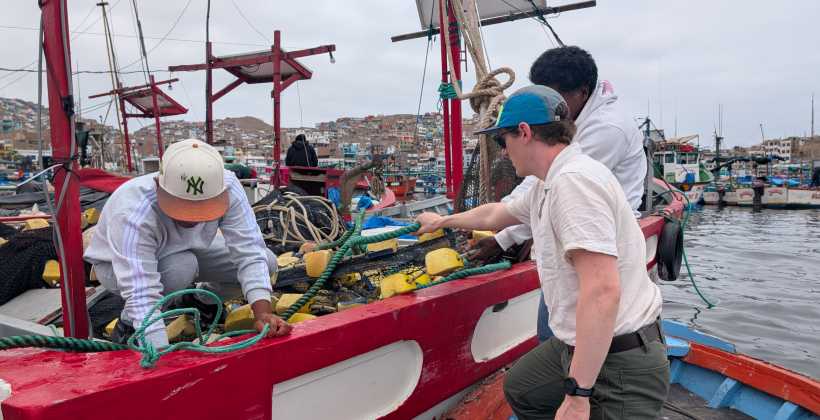
Clean Catch sounds out trial with Peruvian fishermen. Clean Catch, which champions collaborative action to monitor and minimise the bycatch of sensitive marine species in UK fisheries, received funding from The Fishmongers’ Company to meet with fishermen and conservationists in Peru and explore a trial for a cutting-edge bycatch reduction device.
Backed by Defra, Clean Catch brings together fishermen, scientists, technologists, eNGOs, policymakers, and others to develop and trial ways to better monitor and reduce bycatch of sensitive marine species such as dolphins, seabirds, and sharks. Among its work is the development of a prototype ‘Passive Acoustic Reflector’ (PAR), which has been led by Clean Catch partner Arribada Initiative. PARs are designed to reflect the echolocations of dolphins and porpoises, and to alert these animals to the presence of nets they might otherwise become entangled in. While the approach is similar to that of pingers, which are sound-emitting devices already used in fisheries around the world to avoid small cetacean bycatch, the Clean Catch PAR could offer a cheaper and lower-maintenance alternative. It has also been designed to fit seamlessly into daily fishing operations, with UK fishermen able to use it in place of floats on the headlines of their gillnets.
The Clean Catch PAR has already undergone robustness testing at sea, successfully passing through a hydraulic hauler. However, because in UK waters the bycatch of porpoises and dolphins can be rare for individual fishermen, it is more challenging to test whether the PAR performs as intended; a lack of bycatch might be because of a lack of small cetaceans in the area, rather than the PARs keeping them away from nets. One potential solution is to test the PAR abroad, in a fishery where vessels experience bycatch of dolphins and porpoises much more regularly. With Peru’s small-scale fishery identified as a potential candidate, a grant from The Fishmongers’ Company under its Ocean Conservation Programme funded four members of Clean Catch to visit Peru in December 2025, to fact-find and establish local connections.
The trip was facilitated by Peruvian eNGO Pro Delphinus, which already works closely with fishers on bycatch monitoring and mitigation projects designed to support livelihoods and protect a range of sensitive marine species. Accompanied by the founders of Pro Delphinus, Joanna Alfaro and Jeffrey Mangel, the Clean Catch team first visited the northern port of San José and the fishing association there. Comprising vessels of between 3 and 15 metres, and crews of 2 to 5, the fishery uses driftnets to catch a range of target species from mahi-mahi to sharks. Fishermen shared their experiences of fishing and of bycatch with the Clean Catch team, explaining that while catches have been progressively falling over the last few decades, they remain proud of their way of life. While in San José, a meeting was held with the local women’s collective, formed of wives of fishermen in the port. According to the members, being part of the group has empowered them by raising their profile in the community and increasing their knowledge about their role in conservation.
A visit was also made to the port of Pucusana, south of Peru’s capital Lima. There, members of Clean Catch toured the harbour and took a closer look at the types of netting used by local small-scale vessels to determine what adjustments might be needed to the PAR, which has been developed chiefly for UK fishing operations. The trip was rounded off with a workshop between Clean Catch and Pro Delphinus to outline a design for a PAR trial, rooted in principles of co-design and equitability with fishermen, inclusion of women, capacity-building, and scientific rigour.
Following the trip, Jeffrey Mangel said:
“It was a real pleasure meeting and working with the Clean Catch team. We think there is real potential to work together on fishery trials that can be beneficial to fishermen and fisheries in both the UK and Peru.”
A report on learnings from the trip, and the potential design of a PAR trial with Peruvian small-scale fishermen, is now available on Clean Catch’s website.
On behalf of the Fishmongers’ Company’s Fisheries Charitable Trust, Fisheries Programme Manager Sharmin Rouf commented:
“We are proud to have enabled this knowledge exchange trip to happen, with collaborative efforts to trial and up-scale new bycatch mitigation approaches an important part of our vision of a brighter future for the UK’s seafood industry and marine ecosystems.”
Image: Clean Catch