NEW OPEN SOURCE AI SOLUTION TO TRANSFORM GLOBAL LONGLINE TUNA FISHERIES

New open‑source AI solution to transform global longline tuna fisheries with near real‑time catch verification. The Nature Conservancy released its full AI-powered electronic monitoring solution as open source to advance ocean conservation, combat illegal fishing and usher in a new era of data‑driven fisheries management.
In a first for global fisheries, The Nature Conservancy has unveiled a transformative new solution designed to help stem the tide of illegal fishing through rapid catch verification at sea: the first end‑to‑end, open‑source system that embeds artificial intelligence directly onto electronic monitoring systems to deliver near real‑time verification of fishing activity. After three years of prototyping and stress‑testing the technology in the Eastern Tropical Pacific, the organisation has demonstrated that edge‑based AI can reliably analyse electronic monitoring footage of fishing activity onboard, compare predictions to captains’ electronic logbooks each day and flag potential non‑compliance before vessels return to port—closing a transparency gap that has persisted for decades. By making the full solution publicly available, The Nature Conservancy aims to accelerate global adoption of AI‑enabled monitoring and unlock a new era of data‑driven fisheries management.
The health of the world’s oceans and the communities and economies that depend on them hinges on the ability to sustainably manage industrial fisheries. Industrial fishing takes place across more than half of the ocean’s surface—an area three times larger than all the world’s farmland—and supplies seafood to billions of people. Yet nearly 90% of global marine fish stocks are fully exploited, overexploited or depleted. For decades, fisheries managers have lacked the timely and verifiable data needed to manage increasingly complex fishing operations and meet growing demand.
In most industrial fisheries, vessels are required to report their catch, but without independent monitoring, catch reporting is largely unverifiable, creating conditions for licensed vessels to engage in illegal, unreported and unregulated (IUU) fishing. In today’s world, the first mile of industrial fishing often lacks transparency and accountability, and the source of truth used for both science and compliance purposes is largely self-reported and unverified.
This application of AI equips decision-makers with the timely, granular intelligence needed to move from data-poor management to proactive stewardship.
Vienna Saccomano, Senior Scientist at The Nature Conservancy:
“For electronic monitoring to truly work at a global scale, it has to be accessible, affordable and fast,” said Ben Gilmer, director of large‑scale fisheries at The Nature Conservancy. “That’s why we’re making this technology freely available—to allow governments, scientists and industry to build from the same foundation and accelerate a future where verified on‑the‑water activities and accurate fisheries data are not just an aspiration, but a global standard critical to science based-management, market access and combating illegal, unreported and unregulated fishing.”
Closing the transparency gap at the start of the seafood supply chain
Electronic monitoring—using onboard cameras, GPS and sensors to document fishing activity—has long been recognized as a promising tool to improve transparency and ensure managers have verified data for science-based management. However, adoption has been limited by the high cost and logistics of reviewing massive volumes of video. Currently, hard drives are often shipped to human review centres and analysed months after a vessel returns to port, and after seafood has already entered the supply chain.
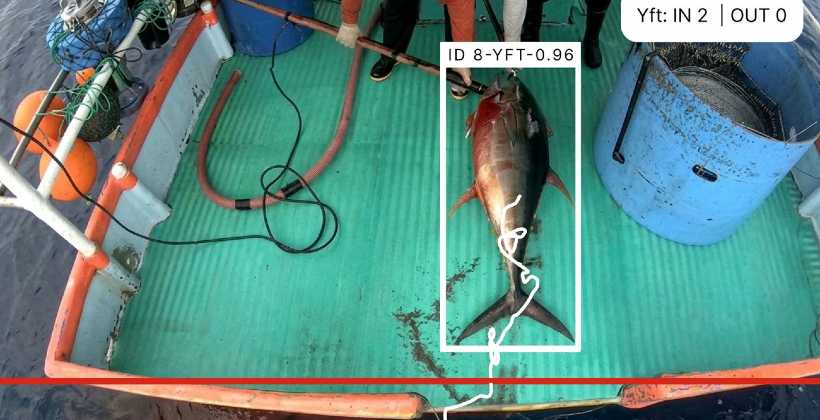
TNC’s AI-powered system changes this paradigm. The system uses edge computing, a form of AI that makes processing data faster, to analyse EM video directly onboard longline fishing vessels, which are equipped with Starlink terminals that transmit daily summary reports over secure Wi‑Fi.
“The implications of the AI-powered system for conservation are profound,” said Vienna Saccomano, senior scientist at The Nature Conservancy, who leads the initiative. “Near real-time fishing insights bring transparency to one of the most opaque corners of the seafood supply chain. It means that managers are no longer forced to rely on delayed or inaccurate self-reported catch data from logbooks. Instead, they can act swiftly to deter illegal fishing before product enters the supply chain. This application of AI equips decision-makers with the timely, granular intelligence needed to move from data-poor management to proactive stewardship.”
From months-long review to near-real time monitoring
Prototyped in the Eastern Tropical Pacific, the system integrates historically siloed components of fisheries operations and makes them interoperable on edge devices. Computer vision models detect, track and classify catch as it is brought onboard, creating a monitoring system that is greater than the sum of its parts.
“Reviewing EM footage used to take months. With edge AI running onboard the vessel, we brought that down to minutes,” said Alan Descoins, CEO of Tryolabs. “The system achieves a 6% catch count error compared to expert reviewers and generates daily risk reports at sea, delivering timely, actionable intelligence to decision-makers.”
Designed to work with people, not replace them
What sets this system apart is not only the technology, but how it is designed to be used. The system is designed to complement, not replace, human expertise—automating the most time-intensive video review tasks while keeping experts in the loop to validate AI predictions. Reviewers receive daily summary reports that include AI predictions on species-level catch insights, fishing risk profiles and associated footage, enabling redirection of time and resources toward higher value activities, such as enforcement, and implementing on-the-water improvements while maintaining accountability and trust in the data.
The system is designed to complement, not replace, human expertise—automating the most time-intensive video review tasks while keeping experts in the loop to validate AI predictions.
Built for reuse and global scaling
Over the past two years, TNC collaborated with a broad group of partners to develop and pilot the system in the Eastern Tropical Pacific, with Tryolabs setting strong performance benchmarks and building the full solution stack now available to the public.
The prototype was selected as one of 15 global awardees in the Bezos Earth Fund’s AI for Climate and Nature Grand Challenge. The award provides $2 million in funding to help bring this system to scale by mobilising the AI-powered system in the Western and Central Pacific Ocean, the heart of the world’s largest industrial tuna fishery, including The Republic of Palau:
“Palau is proud to help steer a bold new course for the future of sustainable tuna fisheries, guided by innovation and shared stewardship. As a committed member of the Parties to the Nauru Agreement, we know that our strength lies in working together to safeguard the world’s most valuable tuna stocks,” said Keith Mesebeluu, chief of Division of Oceanic, Bureau of Fisheries; Ministry of Agriculture, Fisheries, & Environment for The Republic of Palau. “By embracing AI tools in our electronic monitoring program, we are taking a bold step toward greater transparency, efficiency and scientific rigor. This technology empowers us to protect our resources, support our communities and demonstrate that Pacific Island nations are not just participants in global fisheries management—we are pioneers shaping its future.”
This critical work is made possible through collaboration with the Patrick J. McGovern Foundation and the Bezos Earth Fund.
To learn more, visit www.nature.org/edgeai.
Tryolabs is an AI and data partner that helps organisations turn data and AI ambition into production-ready systems. With 15+ years of experience, we work with companies and institutions across industries to design and deploy custom machine learning solutions that are robust, scalable and built to perform in the real world. Our expertise spans computer vision, MLOps and edge AI, with a track record of shipping systems that operate reliably in complex, resource-constrained environments.
The Nature Conservancy is a global conservation organisation dedicated to conserving the lands and waters on which all life depends. Guided by science, we create innovative, on-the-ground solutions to our world’s toughest challenges so that nature and people can thrive together. We are tackling climate change, conserving lands, waters and oceans at an unprecedented scale, providing food and water sustainably and helping make cities more resilient. The Nature Conservancy is working to make a lasting difference around the world in 83 countries and territories (39 by direct conservation impact and 44 through partners) through a collaborative approach that engages local communities, governments, the private sector, and other partners. For more news, visit the The Nature Conservancy’ newsroom or follow The Nature Conservancy on LinkedIn.
Image: The Nature Conservancy