WHAT DECADES OF DATA ON PLANKTON POPULATIONS ARE TELLING US ABOUT CLIMATE CHANGE

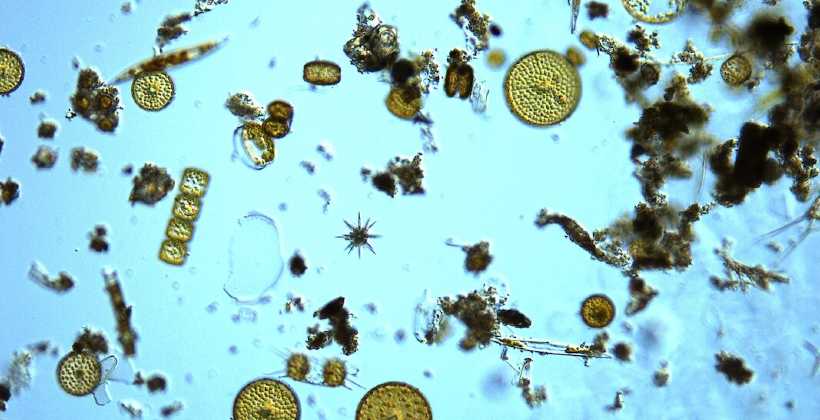
What decades of data on plankton populations are telling us about climate change. Unique long term UK-led ocean monitoring may explain why plankton populations thousands of miles apart are rising and falling in unison.
As climate change reshapes the seas, a century-spanning dataset collected by the Marine Biological Association’s Continuous Plankton Recorder (CPR) Survey has revealed a remarkable pattern: from plankton blooms to predator populations, marine species across vast distances are moving in step, in a synchronised shift offering new insight into the planet’s changing pulse.
Populations of microscopic plankton drifting in British seas have been rising and falling in sync with those in distant waters, in a phenomenon that scientists call ‘spatial synchrony’.
Now, researchers are using the UK’s world-leading marine survey data to understand what’s driving this global pulse, and why it matters in a rapidly changing climate.
In a study published in Ecology Letters, an international team led by the University of Kansas and co-authored by Dr Lawrence Sheppard of the Marine Biological Association (MBA) shows that long-term monitoring is crucial in detecting these deep-time patterns in nature. Their work uses over 70 years of data from the CPR Survey – the world’s longest-running biological survey of the ocean – to uncover how synchronised ecological shifts are playing out beneath the waves.
“Thanks to the CPR Survey, we’re able to see how plankton populations thousands of kilometres apart can be influenced by the same environmental forces,” says Dr Sheppard, CPR Research Fellow at the MBA. “It’s not just that these long datasets give us better statistics – they allow us to see things we’d otherwise miss.”
Tiny organisms with global impact
Plankton may be microscopic, but they are a cornerstone of the marine food web, feeding everything from fish to whales, and they play a vital role in carbon cycling, helping to draw carbon dioxide from the atmosphere into the ocean.
By towing CPR devices behind commercial ships, scientists at the MBA have amassed an impressive dataset spanning vast swathes of the ocean over many decades. Their findings suggest that major changes in the marine environment, from warming waters to shifting currents, can ripple across ecosystems in synchrony, triggering mirrored responses in species thousands of miles apart.
One particularly striking example is a simultaneous shift in UK plankton populations in the 1980s, known to coincide with a broader ‘regime shift’ in the North Sea, when sea temperatures, fish stocks and nutrient cycles all underwent abrupt change.
Most of the synchrony in phytoplankton could be explained by simultaneous changes in ocean temperatures and the numbers of zooplankton consumers, all related to the climate of the North Atlantic. These latest results identify more synchronous changes in phytoplankton abundances in recent years.
“Synchrony is very common in all environments,” explains Dr Sheppard. “It’s a real, measurable phenomenon in the oceans, and it helps us to understand how climate patterns or large-scale environmental drivers affect life across entire marine ecosystems.”
An ecological early warning system
The study also highlights the power of the CPR Survey to underpin new analytical methods. These tools are helping researchers to pinpoint the complex interplay between climate variability and ecological feedback loops, known as ‘interacting Moran effects’, which can drive synchronised changes across species and geographies.
Already, these insights are being applied to understanding synchrony in kelp forests, cross-boundary food webs, and even agricultural pest outbreaks and disease dynamics.
Daniel Reuman, the study’s lead author, adds:
“Long-term data allow us to detect not just whether synchrony is occurring, but why, and that’s crucial in an era of accelerated environmental change.”
Call for continued support for marine science
The CPR Survey’s significance is hard to overstate. It has been recognised by Guinness World Records for travelling over 7 million nautical miles across the globe over decades, and is a key tool for providing excellent data for scientists and policy makers.
Thanks to the generous support of more than 350 commercial vessels such as ferries and container ships, the survey has expanded its traditional sampling areas from the North Sea and Eastern Atlantic to the Polar regions, Pacific, South Atlantic, Mediterranean and the Great African Lakes.
As marine ecosystems face mounting pressure from warming seas, plastic pollution and biodiversity loss, it is more important than ever to use long-term datasets, such as the CPR Survey, to accurately and methodically monitor the ocean’s health and assess the impact on climate change and human health.
“This is about safeguarding the future of our oceans,” says Dr Sheppard. “We can’t understand what’s changing, or how to protect marine life and livelihoods, without sustained observation.”
The MBA is calling for continued investment in long-term ecological monitoring – not only to track changes already underway, but to prepare for those yet to come.
Explore the CPR Survey and its legacy here.
Image: Microscopic plankton shift in synchrony with plankton populations thousands of miles away. © Marine Biological Association