THE IBTS EXPEDITION: HOW IT WENT IN THE NORTH SEA

The IBTS expedition: How it went in the North Sea. The international bottom trawling expedition has finished.
“This year’s expedition had a pretty intense programme,” says marine scientist Côme Denechaud.
He was the captain of this year’s summer edition of the International Bottom Trawling Survey (IBTS), which was recently completed.
During three weeks at sea, the expedition participants on “GO Sars” have taken samples and measurements from 60 plankton and egg stations and 53 bottom trawl tails. The CTD, which measures temperature, salinity and depth, has been sent overboard at 125 stations.
Codfish, rare sightings and a rusty barrel
The expedition takes place twice every year – once in the winter and once in the summer.
“Several countries are collaborating to cover the entire North Sea during the expedition, and the data is used directly in the management of the most important species in this area,” explains Denechaud.
Norway will be responsible for the northeastern part, but our stations extend all the way to Shetland. In addition to the usual surveys and IBTS stations, the expedition participants have tested and calibrated a new trawl.
This year, a total of 200 different species were registered. The most numerous were haddock, whiting and saithe.
“We also made some exciting discoveries, such as a critically endangered giant ray. We measured this before releasing it alive again. In addition, we found a rusty oil barrel that now houses hundreds of sea snail eggs,” says the boat captain.
“Further north and along the Norwegian Trough, large numbers of southern species such as boarfish ( Capros aper ) and bluegill ( Helicolenus dactylopterus ), which are now well established in the North Sea, were still caught.”
Also monitors pollution in the ocean
The researchers have also taken samples to monitor pollution in the marine area.
Two guests from the Directorate for Radiation Protection and Nuclear Safety (DSA) joined this summer’s expedition. DSA coordinates Norway’s national monitoring of radioactivity in Norwegian coastal and marine areas, where HI contributes, among other things, by taking samples, processing samples and analysing radioactive substances.
At the same time, HI also monitors organic pollutants in Norwegian sea areas.
“We collected samples from 11 water stations, one from bottom water and the rest on the surface, which will contribute to this monitoring, and eight sediment samples. In addition, we collected samples from muscle and liver of fish for several of the target species caught at IBTS stations in certain areas,” says Denechaud.
These samples have now been taken ashore and will be analysed for traces of environmental toxins, hydrocarbons, metals, radioactivity and biomarkers.
The results of the expedition will be published in a separate expedition report.
Image:
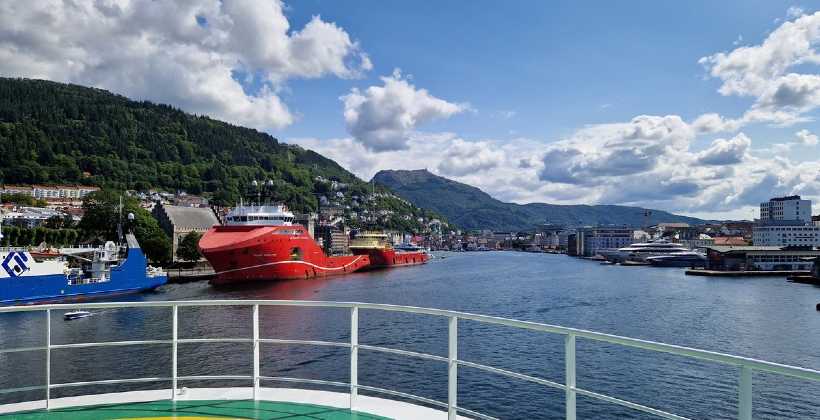
After three weeks in the North Sea, “GO Sars” returned to Bergen. Photographer: Yves Reecht / Institute of Marine Research