THE TURKISH RAID AND WESTMAN ISLANDS FOLKLORE

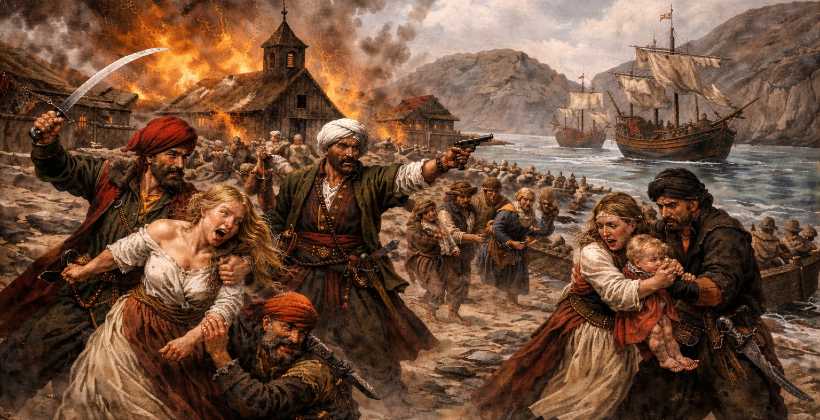
The Turkish Raid and Island Folklore. Fish Focus’ latest feature follows our trip to the Icelandic archipelago, Vestmannaeyjar.
The Westman Islands (Vestmannaeyjar) are steeped in folklore, history and legend. While they are often associated with fishing, dramatic volcanic landscapes and vast puffin colonies, the islands also carry the memory of one of the most traumatic events in Icelandic history: the Turkish Raid of 1627. This event, along with stories of hidden people, sea spirits and volcanic forces, has shaped the cultural identity of the islands for centuries.
In the summer of 1627, pirates from the Barbary Coast—primarily Algerian and Moroccan corsairs operating under the Ottoman Empire, raided the Westman Islands. Although the event is known in Icelandic history as the Tyrkjaránið (the Turkish Abductions), the attackers were not Turks but North African Muslims who were broadly labelled as such by Europeans at the time. The raid was swift and brutal. Dozens of islanders were killed and around 240 people, mostly women and children, were captured and taken across the Atlantic and Mediterranean to slave markets in Algiers. While a small number were eventually ransomed and returned years later, many never saw Iceland again.
The raid left a deep psychological scar on the islanders, one that still echoes in local legends and oral traditions. Stories tell of women hiding in sea caves or beneath cliffs to escape capture and of desperate resistance by farmers and clergy. One well-known account describes Pastor Jón Þorsteinsson who was reportedly killed inside the church while trying to protect his congregation.
Ghost stories are also tied to the event, including that of a woman who escaped the pirates by throwing herself into the sea and is said to haunt the coastline, warning others of danger. Today, the memory of the raid is preserved in museums such as the Sagnheimar Folk Museum and remains an important part of the islands’ cultural consciousness.
Alongside these historical memories, the Westman Islands share in Iceland’s long tradition of belief in elves and hidden people known as huldufólk. These beings are said to live within rocks and cliffs and are treated with great respect. Certain areas are avoided during construction to prevent disturbing their dwellings and offerings are sometimes left in exchange for protection, particularly for those who make their living at sea.
Elves are believed to influence weather and fate, guiding respectful fishermen home during storms or leading the careless astray. The lava fields and cliffs of Heimaey, the main island, are especially rich in such stories, often linked to strange sounds, sudden fog or unexplained misfortune and luck.
The sea itself plays a central role in the islands’ folklore and is often portrayed as both a giver of life and a source of terror. Many tales speak of drowned sailors returning as spirits, appearing as flickering lights along the shore or visiting loved ones in dreams. One legend tells of a ghost ship that appears before major storms, serving as an ominous warning to fishermen. Stories of selkies—seal-people who can shed their skins to become human are also found. In one local tale, a man steals a selkie’s skin and forces her to live as his wife until she eventually finds it and returns to the sea, leaving him behind.
Volcanic activity has added a more recent layer to the islands’ folklore. The 1973 eruption of Eldfell on Heimaey is remembered not only as a natural disaster but as a near-mythic event. Some locals describe it as the revenge of a fire giant for disturbing the land while others claim the eruption was foretold through dreams or sensed by animals beforehand. Remarkably, almost the entire population was evacuated overnight and very few lives were lost, an outcome many attribute to divine or supernatural protection.
Today, these stories remain very much alive. Museums, festivals such as the annual Þjóðhátíð celebration and local storytellers continue to pass them on to new generations and visitors. Together, the folklore of the Westman Islands reflects the isolation, danger and resilience of life on these windswept volcanic rocks. From memories of pirate raids to mystical sea creatures and fiery eruptions, these tales form a living testament to the endurance and imagination of the islanders.
We will be posting an article every day, covering this amazing trip and showcasing the Icelandic Seafood industry, cutting edge aquaculture, Icelandic heritage and the hospitality of the Icelandic people. You can read the whole publication here
Image: ©Fish Focus